Sunday, January 15, 2017: Davis Mountains, Texas

Two nights ago, I was at a nice Army Corps of Engineer Campground where mule deer spent the early evening grazing around the campsites.

Today, I started early because the forecast was for high winds in the afternoon and the RV is just not fun to drive under those circumstances.

I headed west on I-10 and then drove south 25 miles to Ft. Davis, and got a campsite at the State Park.  The weather finally started clearing and the winds picked up, but I decided to drive the 75 mile scenic Davis Mountains loop.  It was a beautiful drive and I enjoyed seeing the sun and the mountains after the last three days of gloomy skies and flat scrubland.


I stopped briefly at the McDonald Observatory, but their tour was going to take three hours and that would not give me time to finish the scenic drive.  I was going to take the self-guided tour, but when I made the turn to go to the telescopes, a big sign said NO RVs.  Bummer.

The newest and largest telescope at 394".

I finished driving the scenic loop through the mountains on the highest highway in Texas, encountering a short snow squall at the higher elevations, but returned to 50 degrees at the bottom and sunny skies.


Views of the Observatory with the older, smaller telescopes on the left

Many warning signs about not driving through standing water with these gauges next to the road to show just how high the water can get from flash floods


This formation is called Sawtooth


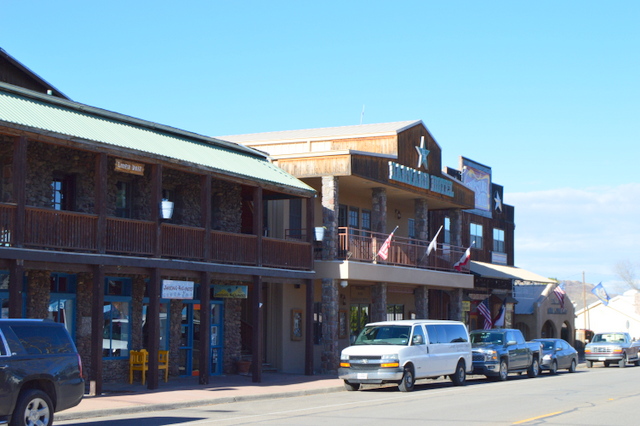
The small downtown Fort Davis
I returned to the State Park and set up camp, then took a walk around the park.  No phone, no reliable internet, no tv here, but did find one NPR station so I could at least hear the news.

Incredible stargazing here because of the extra dark skies, but too windy and cold for me to enjoy the stars for long.

Saturday, January 14, 2017: Texas, Texas and more Texas

After my stop in Dallas, I stayed the night just outside of Ft. Worth.  Then took Route 377 and 67 southwest across the central part of the state.  Last night I stayed in another great Army Corps of Engineers Campground on a lake and tonight I am in a commercial park in Ft. Stockton where they have a laundramat.

I am traveling across the widest part of Texas and it goes forever.  I got off the Interstates for the last two days, but there is still nothing to see except a town every couple of hours or so.  Looking forward to escaping Texas in the next day or so.  I may make a stop at Fort Davis for a day or two, depending on weather.  It has been rainy for the past two days and I am looking forward to those nice Arizona dry warm temperatures in a few days.

Thursday, January 12, 2017: Kilgore, TX to Fort Worth, TX

Woke to heavy clouds and 65 degrees and breezy.  First thing this morning, I had to drive over to the town admin offices to pay for my campsite last night in their nice town campground.  Turning onto Main Street, I see these giant oil derricks behind the stores on Main Street, all topped with stars that light up - I meant to ask if the stars were just for Christmas or all year round.  Kilgore was the train town that boomed when the east Texas oilfield was discovered in 1930, similar to the gold rush towns. The derricks represent the past and present of the area.
Main Street, Kilgore, Texas
Old time Theater in Kilgore, Texas


I drove a few miles to Kilgore college to explore the East Texas Oil Museum.  Just outside the entrance is an oil derrick and inside is one of the best museums I have ever seen.  They had interactive exhibits showing the technology of drilling for oil then and now, including fracking for gas, as well as the history of the local oil discovery and its impacts on the town.  They recreated Main Street from 1930 inside the museum with shops and stores and told the story of "Dad" Joiner who discovered the first well that led to the boom.  The East Texas Oilfield was the largest oil deposits ever found in 1930 and so much oil was pumped that oil prices plummeted from $1.10 a barrel to $0.15.  T with his was probably the only place in America that was not suffering from the depression.  This museum is an absolutely must see if ever in Northeast Texas.

Recreated 1930 Main Street in the Museum

These marionettes were viewed from an "elevator" that took you down through 3,000 feet of rock to see the oil.  Great for kids, but I enjoyed it, too.

More 1930's Main Street, inside the Museum

Changing/Adding Pipes to a drill

For Jack - the Kilgore 1930 bank vault is on the left.


Back on I-20, I drove into downtown Dallas to see if I could visit the Sixth Floor Museum about JFK's assassination in 1963 and his legacy.  Worried about finding parking, I luckily found a surface parking lot that only charged me for 2 spots, so $14 and just a minute's walk from the museum.  Absolutely no photography in the museum, but it was a traditional gallery with lots of photos and some videos with an audio cassette that provided background.  I saw the actual room set up with the Oswald's rifle sniper's "nest" the exact way the FBI found it with boxes assembled to provide a resting area as he shot through the window into the back of the cavalcade.  They spent a lot of time on the evidence for Oswald's guilt as well as alternative theories.  A few tissues were needed to get through the video clips of the funeral and then the museum focused on Kennedy's legacy of holding off Russian nuclear weapons in Cuba, civil rights, and the Peace Corps, etc.
The book depository and sixth floor corner window (square, next to highest floor) where Oswald hid. 

After the museum I walked over the JFK memorial by Philip Johnsons, designed as an "open tomb."  Walking back to the parking lot, I stopped to visit the "grassy knoll" where some folks thought at least one shot had originated that supported many of the conspiracy theories, but today they think it was just the tall buildings that distorted the sounds depending upon where you were standing.  A very worthwhile stop.
JFK Memorial

The grassy knoll today

I hit terrible traffic leaving Dallas and again in Fort Worth, so did not get to my campground southwest of Ft. Worth till after sunset, but luckily not totally dark.  A great spot on a lake by the Army Corps of Engineers.

Whew, what a great day!

Tuesday, January 10, 2017: Meridian MS to Pioneer, LA

I left this morning about 10am and continued west with a quick stop at the Mississippi Craft Center where I found two beautiful stained glass pieces; the first was a magnolia blossom and the second was a grouping of three women.


We had been looking for a nice piece to go in the opening between the living room and the breakfast nook.  I couldn't reach Jack right away, but he surprised me saying that he liked the second one.  I had left the craft center and realized I did not ask the price of the second piece and assumed it would be similar to the first one ($335), so I called and received the bad news that it was a bit more -- $2,100!  Oh well, I had been thinking more of a great blue heron, a white egret and some marsh, so will keep looking.

I continued west on I-20 from hilly western Mississippi across the Mississippi River to totally flat farmland in Louisiana.  I stopped at Poverty Point Reservoir State Park for a campsite.  Reviewing the brochure the check-in office provided, I saw warnings about alligators AND black bears!  What's up with that?


The weather is in the low 70's, but very windy and cloudy.  Took a walk down to the reservoir and saw lots of cormorants and great blue herons.  Beautiful area.


Sunday, January 8, 2017: Andersonville, GA to Montgomery, AL

Woke to temps in the low 20's - this is just wrong!

 I stopped at the Visitor Center to watch two movies - one is about the civil war prison and the other is about Prisoners of all wars, with a lot of interviews with WWII, Korea and Vietnam vets, including John McCain.  I then visited the museum that had artifacts from prisoners of all US wars.  The first thing they emphasized was that humane treatment of prisoners is a relatively new concept and that the definition of prisoner of war is complicated.  For example, to be considered a prisoner of war, one has to be in the military, therefore embassy non-military personnel held hostage are not prisoners of war).  Spies also are not prisoners of war, so when Nathan Hale was caught by the British, he was carrying hidden papers from George Washington, and was hanged as a spy.  Of course, prisoners of war have routinely not been treated humanely regardless of the various Geneva convention agreements.  The museum highlighted revolting events like the Bataan Death March and at first I was depressed and could only see the horrors, but then I began to see that it was trying to also point out the heroism and brotherhood that existed among the prisoners that kept their morale up and enabled many of them to survive.

I used their cd to do the auto tour through the Andersonville civil war prison site (officially Camp Sumter).  It was a 16 acre (later expanded to 26 acre) hilly field with a small stream running through the center that served as the only source of water for the entire camp and a 7' stockade fence around it.  Built to house about 10,000 men, within one year, it held 33,000 when the north refused to continue to swap prisoners because the Confederates were enslaving the black prisoners of war.  There were no buildings and the men made shelters from the cold and rain from any scraps of material they had brought or could find.  Of the 45,000 that went into the gates in the 1 1/2 years it was open, almost 13,000 died of disease and starvation.  The commander of the prison was hanged after the war.  Although Andersonville is probably the best known civil war prison, there were others both in the north and south that had similar death rates - including the one in...wait for it.....Elmira!
A 7' Stockade fence surrounded the camp

A view of the Camp from the opposite end with the stream in the middle

This shows where the stockade fence was.  The inside white stakes show where there was a simple split rail fence that was called the "Deadline" beyond which prisoners were shot by the guards atop the stockade

A recreation of the types of shelters the men built for themselves

I then visited the cemetery which is still an active veteran cemetery.  During the civil war, graves were marked with a stake and a number.  Fortunately, a prisoner who worked at the hospital copied down the names and numbers of the deceased so that he and Clara Barton were able to get the graves identified by name.
Entrance to Cemetery

New Jersey Monument


Had to add the New York Monument for Jack

A monument for the WW II Stalag 17 Prison


So much cruelty and death -- how can we continue to do this to each other?

I spent all morning and then drove a few hours to Montgomery, Alabama.  Jack and I had been here a few years ago and had seen the civil war and civil rights sites.  Today, I wanted to stop by the only museum dedicated to F. Scott and Zelda Fitzgerald.  He has always been one of my favorite authors (This Side of Paradise, Great Gatsby, Last Tycoon, etc.) and their real life was more melodramatic than any of those.  The museum had artifacts from both of their lives.  He and Zelda both grew up in privleged homes and their engagement was on again/off again depending on whether and when his first novel was getting published.  It eventually was published to rave reviews and they were married a month later.  They epitomized the roaring 20's with constant partying, drinking, and traveling as they tried to live the elite bohemian lifestyle of the times.  Zelda was eventually institutionalized for life, probably bi-polar disorder although they called it schizophrenia at the time.  Her sister also suffered mental issues and her brother committed suicide.  F. Scott Fitzgerald spent enormous sums of money on her care and boarding schools for their only child at the same time his new novel, The Great Gatsby, was panned by critics and he resorted to writing short stories for magazines and finally writing screenplays for Hollywood to stay financially viable.  He died of a heart attack at 42 years of age, a literary failure.  His daughter is given enormous credit for maintaining his reputation and having a paperback edition of his books sent to the troops in WWII.  The troops came home, raving about the books, and so F. Scott Fitzgerald became a best-selling author once again in death.
His "Thoughtbook" from College Days at Princton

     
Stopped for the night at an Army Corps of Engineers park on Woodruff Lake just outside Montgomery that had electric hookups as it is forecast to be very cold again tonight.

Saturday, January 7, 2017 SC to Andersonville, GA

Happy New Year!

I am starting 2017 off with a trip to the famous Quartzsite rally in Arizona (check it out on Wikipedia).  Thousands of RVs descend on this small town in the southern Arizona desert close to California border.  There is a monster RV show along with gem shows and giant flea markets to keep folks occupied while they enjoy the dry warm days and cool nights - perfect for RV camping without any facilities, called "boondocking."  I am planning on generally driving I20 west to I10 with lots of stops along the way to break up the monotony of driving cross country.

Escaping the cold weather snap that threatened to possibly bring snow and ice to Charleston and the rest of the south, I decided to get out before the roads could ice up later Saturday night.  Got on the road about 11:30 and drove south on I95, then west on I16 - cloudy and light drizzle a couple of times, but roads were dry.  Driving across Georgia, I enjoyed seeing many sod farms with their huge fields of bright green grass.  These eventually gave way to pecan tree orchards, then cows in their pastures.

 I stopped for the night at a city-run campground in Andersonville, Georgia.  I needed to have electric because the forecast is for below freezing temps all night and although the furnace is propane, the blower fan uses a lot of electricity that would drain my batteries by morning. The campground is small, nothing fancy, but has electricity and is convenient for my visit tomorrow to the National Prisoner of War Museum and the Andersonville civil war prison and cemetery.

Thursday, August 18, 2016: West Virginia to Pennsylvania

Well, it rained off and on all night long.  We love the sound of rain on the RV roof, but this was unwelcome as the golf course was cartpath only.  We again had unreliable phone service, but just a few miles down the road we found Verizon!  So, I called Jill, and we made plans to visit them, arriving Saturday.  My substitute golf plans for the day were to visit Fort Necessity where George Washington achieved his first military honor at the start of the French and Indian War to be followed by a visit to two of the Frank Lloyd Wright houses southeast of Pittsburgh.  We decided that since we still had 500 miles to go to get to Jill and Gord's, we would just visit Wright's Falling Water and skip the other stops.  Over hill and dale again on twisty steep roads landed us there around 10:30, but for some reason, their tours were not going to be available until 2:30.  VERY Disappointed.  Okay, so that gets added to the future To Do List, too!

We let Garmin choose the route and we eventually found the interstate after spending a ridiculous amount of time on what appeared to be one-lane roads.  We drove northwest, skirting Pittsburgh and stopped at a nice campground just south of Erie, Pennsylvania with EVERYTHING!  Electricity, phone service, internet and even cable TV.  We are enjoying civilization again!  And on top of that, the weather is dry, sunny and in the high 70's -- perfect!

This will probably be our last post for this trip as we will be visiting with family and friends in Canada, New York and New Jersey.   Enjoy the rest of your summer.


Wednesday, August 17, 2016: West Virginia's Seneca Trail


We continued our drive north on the scenic Seneca Trail Route 219) alternating between mountain roads with 7% and 8% grades and hairpin turns with beautiful lush farming valleys.  Along the way, we spotted this great old former general store that is now an antiques store.  Begun by his grandfather in 1884, family still runs the general store with a great sense of humor as an antiques store.

The antique store outbuildings


We saw three of these Mail Pouch Barns.

At the end of the scenic area of the drive (Elkins, WV, for those following closely, ahem) we decided we could use a tourist time-out and checked out possible golfcourses.  Our first choice, a Pete Dye course that was built upon reclaimed coal mining land was not open to the public, so we looked further north and found a nice course in Morgantown, near the border of Pennsylvanian, south of Pittsburgh.

Drizzly evening so we didn't get a chance to enjoy the an outdoor Happy Hour
We found a campground less than 10 miles away in a quiet forested area, but then the rains came and they have been having a lot of rain in the area recently, so golf tomorrow morning is questionable as Jack cannot play if cartpath only.