July 9, 2013: Columbia River Gorge to Mt. St. Helens

 Up early to view two of the more spectacular waterfalls in the Gorge.
 The first was Horsetail Falls where we climbed a trail way above the waterfall to a second, smaller waterfall called Ponytail, allowing us to walk behind the Falls.   

Then onto the highest Falls, Multnomah. It is 650 feet and I couldn't get the whole cascade in a photograph without changing the camera lens.
 

In this westerly portion of the Gorge, we traveled the original Oregon scenic Highway 30 built in 1916, a narrow twisting road high above the Columbia River through a rain forest.  The average annual rainfall here is 75" and it declines 1" per mile as you travel East.
Tunnel on the original road, no longer used

Our last stop along the Gorge was at the Vista House and overlook, a beautiful spot.

Vista House


Mt. Hood, OR


Mt. St. Helens
After lunch, we got on the interstate, bypassing Portland and north on I5 to the exit for Mt. St. Helens.  We stopped to get a campsite at the beginning of the 50 mile road that runs up to the mountain.  We saw an incredible film about the eruptions at the visitor center and enjoyed the spectacular views of Mt. St. Helens and its crater. 
Devastation still after 30 years

Jack called the dead tree stumps
graves of Mt. St. Helens


Crater of Mt. St. Helens is slowly building a dome
in the center
 
One of many lakes formed when
eruption debris dammed creeks
 
This photo is NOT blurry.  This is
the way these hillsides look in person
because of mismatched horizontal
tree branches


Stopped for dinner on the return trip back to our campsite at the only open restaurant (the other restaurant on the road only served lunch) and it was a lucky find - excellent food on the open air deck overlooking a creek at sunset.

July 8, 2013: Hermiston, OR to Columbia River Gorge

Another gorgeous sunny and cool morning.  Headed north to Scenic Route 14 in Washington that follows the Columbia River all the way to the Pacific.
 The scenery is brown hills with sagebrush gradually interspersed with verdant vineyards. This is prime wine grape producing country, home of Columbia Crest along with many small regional wineries.  It was morning and I'm not big on wine for breakfast, so we passed on visiting the wineries.

We had problems deciding whether to gaze at the river below or the floating snow covered Mt. Hood directly in front of us as we drove west.

 We stopped at the most unusual memorial to veterans killed in action we have ever seen - a reproduction of England's Stonehenge, set on a bluff overlooking the Columbia River.

Another stop at the Bonneville Dam, a depression era project.  It was fun to watch through underwater windows the fish climbing the ladder to get upstream beyond the dam.  Along the Columbia River w saw lots of windsurfers and kiteboarders.

We stopped at Ainsworth State Park right in the Gorge for the night.

July 7, 2013: Elgin, OR to Hermiston, OR

Cool, 52 degree morning and sunny.  Left our campsite about 10 and continued through a scenic area for a few miles to a medium sized town, LaGrande where we stopped for grocery shopping.

This stretch of I84 was very scenic with a 7 mile 7% grade with not one, but three warnings! It was very hazy, so I wasn't able to get any good photos of the panoramic views of the farmlands stretching away as far as you could see to the horizons in three directions.


Next stop was an Oregon Trail Interpretive Center three miles off I84 with a nice walk through cool and fragrant pine trees to the ridge where the Oregon Trail passed.  They had a reproduction of a covered wagon and few storyboards that documented the rough passage through the Blue Mountains the travelers endured.  It was a great place to have lunch and short nap.

Next up was an Indian museum just west of Pendleton called Tamastslikt Cultural Institute.  We thought it would have been a quick 15 minute stop, but it was a huge building and we spent over an hour exploring the many exhibits and short films learning about the Umatilla, Cayuse and Walla Walla Tribes of the area.  No photos were allowed inside, but we could take pictures of the outside exhibits of traditional teepees and sweat lodges.


A mile or so away was a nice-looking casino with a high rise hotel and an RV park that were all filled with cars and RVs.  This area has an upscale, successful look compared to the downtrodden Indian reservations we had seen in South Dakota.  The museum told the story of how they were cheated out of their lands and their way of life, but the emphasis was on the many successes they have had in bringing back the water that had been stolen and starting a salmon hatchery.  They are actively teaching language and traditional culture to the young people, instilling pride in their heritage.  Very impressive story.


We tried to visit the famous Pendleton woolen mills, but we missed the last tour of the day, so we continued on to our campground 1/2 hour west.  Nice park with paved sites.  Still warm here with 80 degrees at 10pm.  It is dry, so we were able to open the windows and put on the fan and be comfortable.

July 6, 2013: Hells Canyon, ID to Elgin, OR

We were going to put the kayak into the Snake River near our campsite, but we were concerned about the current.  Right here we are between two dams, so it is certainly calmer waters than we saw yesterday, but we don't want to get into a situation where we can't get back to our put-in.

We had a nice breakfast and left the campground mid-morning, heading south to where we cross the Snake River into Oregon.  Then we took the Hells Canyon Scenic Byway through the Wallowa-Whitman national forest.
 
  It is as if we were suddenly transported hundreds of miles away.  From the arid rugged areas of the canyon and East, we found ourselves among tall pines and all types of evergreens, similar to coastal Oregon/Washington.  We stopped at a lookout over the Hells Canyon from the western ridge.  The profusion of white, blue, red and yellow wildflowers along the roadsides burst into acres of color at the overlook.


We continued up and down and back and forth on switchbacks through the Wallowa mountains, finally arriving in a little tourist town of Joseph (named after Chief Joseph).  This area is called the Little Switzerland of America because the village is ringed with 9,000 foot mountains, many still with snow.

We were almost out of fuel, so didn't stop to walk about the town, but pushed on to the next town with diesel to save more than $.30 a gallon.  Looks like we are finally going to see the infamous west coast fuel prices.  We had been paying around $3.70s until Idaho where they moved up to the $3.90s.  Now we are starting to see lots of station over $4.00.

We got a campsite in a Lions park in the little town of Elgin.  Nothing fancy, but full hookups, WiFi, TV and a spotlessly clean laundry.  Once again, the park can handle about 40 units, but there are only six of us here.

Got all our laundry done and enjoyed a cool dry evening sitting outside til dark.  Slept with no AC noise and windows open.

July 5, 2013: Hells Canyon

Woke up a a cool sunny morning.  We spent the morning catching up on the internet.  We have no TV or phone reception, but quick and dependable internet....how'd they do that?

We drove 1/2 hour back down the twisty canyon road to the visitor center where we boarded a jet boat for a tour of the wild and rugged portion of the canyon.  No roads penetrate here for many miles, so boat travel is the only way to see the canyon.  We enjoyed rugged, gorgeous scenery along with thrilling class 4 and class 5 (maximum navigable rapid) rapids and the other folks on board were fun and interesting. 

One of the many rapids the captain had to negotiate


Snow melt creeks feeding the Snake River


We stopped for lunch at a sheep ranch/museum that had been in the canyon years ago.  Just enough flat space for a small garden, orchard and some hay production.  Can't imagine how lonely it would  have been.  Then, our guide told us he lives in a cabin on the river with no road access and his mail (along with his 7 neighbors spread out for miles along with river ) is delivered by boat once a month.  Those little red flags that come with our mailboxes just don't cut it, so they use red banners to alert the mailboat to stop and pick up outgoing mail.  The mailman must stay in the canyon over night to allow his customers to respond to the incoming mail and he picks up the responses the next day.
 
Mailbox on the river


 After 6 hours on the river, we returned to our same capsite exhausted.  A light dinner after the huge lunch they served and a relaxing evening made for one of our best days yet!


July 4, 2013: Caldwell, ID to Hells Canyon, ID

Happy 4th of July! 

We drove west from the Boise area to Hells Canyon that sits on both sides of the Snake River separating Idaho and Oregon.  We first drove up the Idaho side, crossed over to Oregon near the Brownlee Dam and crossed back again into Idaho near the Oxbow Dam and up through the scenic canyon.  There is a campground established and maintained by the Idaho Power Co., about 20 miles south of the third and last dam, Hells Canyon, and we were lucky to get one of the last five open spots with electricity and water, overlooking the Snake River.


It was 98 degrees, so no hiking.  We decided to drive the 20 crooked miles up to the dam and explore their visitor center.  The canyon near the campground is soft brown hills, but became more rugged as we drove downstream.


A glimpse of the rugged canyon downstream from the dam
The visitor center is the end of the road and had a good movie explaining the history of the canyon.  On our return trip, we met this poor guy.


  The water is clear and we saw literally thousands of fish.  This is a fisherman's paradise.


We returned to the RV, waiting for it to cool down to sit outside.  It didn't cool off very much, but a breeze came up and with no humidity, it was comfortable.  No fireworks of any kind allowed here because of the threat of fire, so it was a relatively quiet Independence Day.

It is hard to believe we have been on the road for a month - time flies when you are having fun.  We have put just under 5,000 miles to go less thhan 3,000 miles from home.  Obviously, we have not followed the shortest line between two points, but have been meandering around to enjoy the nicest scenery and try to keep that bucket list from overflowing.

July 3, 2013: Across Southern Idaho

We were in scenic overload, so it was time to get some errands done, like haircuts and washing the RV.  For two days, we drove short days and did our errands. 

Here is a map of our convoluted route from Des Moines, Iowa to Hells Canyon, Idaho


View Iowa to Idaho in a larger map

Southern Idaho is arid, with brown hillsides broken only by the gray-green sagebrush, interspersed with large green fields of wheat and potatoes.  Every farm was irrigating every field - apparently there would be nothing here without the water from the Snake River.

July 1, 2013: Mammoth Hot Springs to Idaho Falls, ID

We woke up to a chilly morning in the low 50's, but the forecast is for another hot and sunny day.  We left Yellowstone via the West Entrance in Montana and took US 20 south to a scenic byway called Mesa Falls.  There were two beautiful waterfalls, including a rainbow.

We went through a few quaint towns and then drove the Teton scenic byway that meanders close to the dramatic Tetons. We had been to Teton National Park a couple of times before, so this view from the West instead of East was sufficient for this trip.


Our GPS got a little uppity today and decided to send us on a wild goose chase on gravel roads through rural farmlands looking for our campground.  When we got to a road closed sign and the detour function wouldn't work, we made an executive decision to override her.  Turned out we were about 15 minutes away, but out here, 15 minutes is the difference between civilization and the boondocks.

The campground near Idaho Falls was supposed to have wifi and it did have two networks, but one didn't work well and the other didn't work at all.  So, my big plans for updating the blog and getting all our photos uploaded to Shutterfly were shattered.  But, the good news is we have electricity and the AC is keeping us comfortable in the mid 90 degree heat.

June 30, 2013: Reed Point, MT to Mammoth Hot Springs, Yellowstone, WY

We drove south to Red Lodge to start the Beartooth Highway - considered one of the most scenic drives in America.  It was truly astounding -- mountain peaks with snow still clinging in spots, miniature wildflowers above the treeline, gnarly pine trees, deep blue lakes, lazy streams that suddenly rush over rapids and then crash over a cliff in a riotous waterfall.  The road tops out at just 10,000 feet at Beartooth Pass.  The photos just don't do justice to everything we saw.

Glimpse of the switchback road


When returning down a gravel path from an alpine lake, we saw a man waving a large antenna-looking contraption.  I had to ask,  "whatcha doin?" and he explained that he was on his way to the ski slopes (yup, on June 30th!) and he decided to stop a see if he could find some foxes that had been tagged and released. 
 
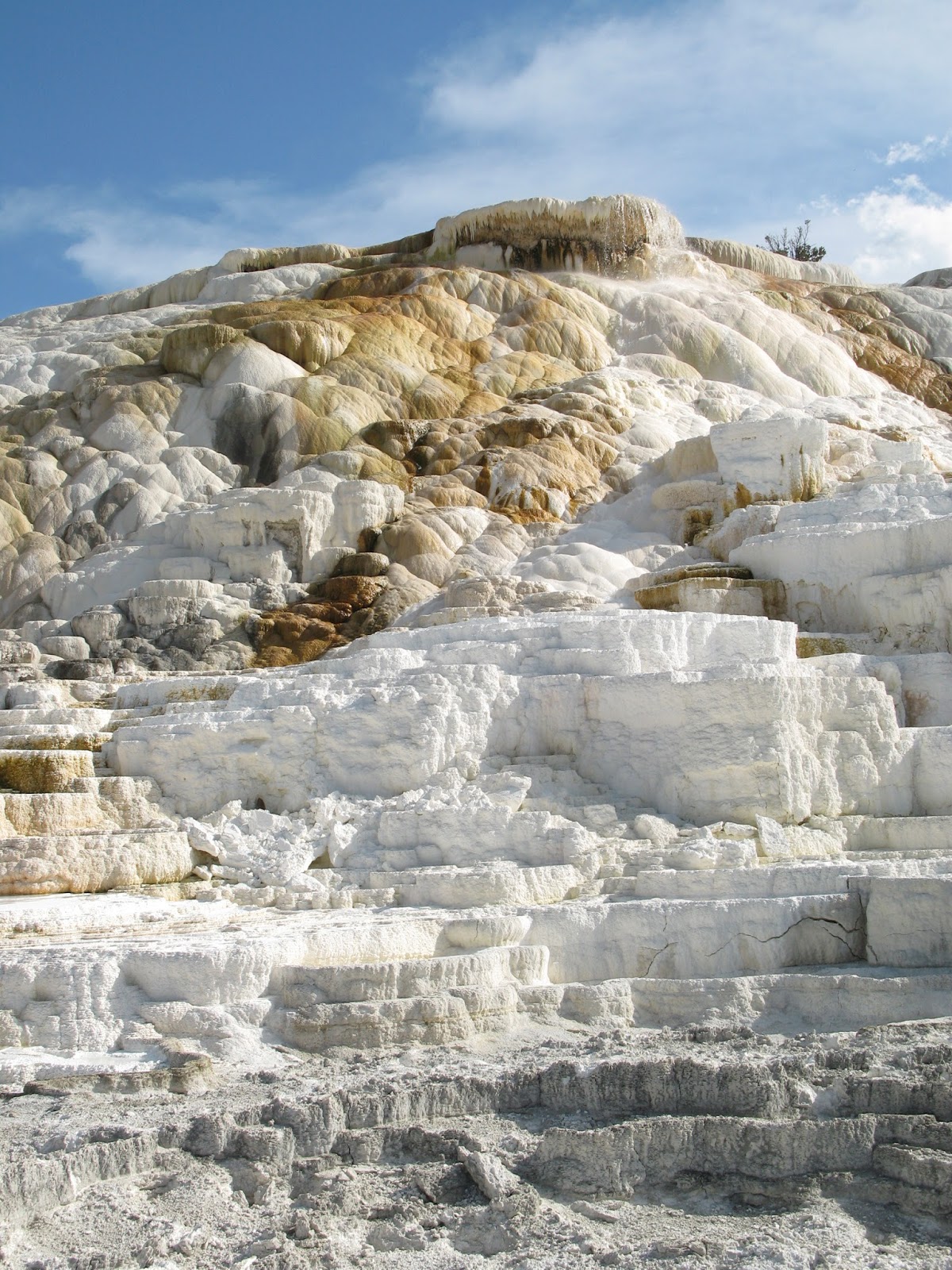
We arrived in Mammoth Hot Springs in the northwestern part of Yellowstone and got a nice campsite right in the park, but no electric or water.  It was 90+ degrees and with no electricity, we had no AC, so went exploring the Mammoth Hot Springs Terraces.  We had been here quite a few years ago, but the Terraces were dry.  This time, they had water flowing and were incredibly beautiful. 


We returned to the RV, made dinner, sat outside a while, played cards and enjoyed a great nights sleep in the cool, quiet, super dark night.
 

June 29, 2013: Belle Fourches, SD to Reed point, MT

We left our still empty campground, driving scenic route 212 across hilly grazing lands and occasional red cliffs with views of Devils Tower in Wyoming, then back to grazing lands in Montana.  We went over a couple of passes around 7,000 feet.

 We stopped for what we thought would be a quick 15 minute tour of Custer's Last Stand Memorial at the Little Big Horn National Monument, but an hour later, we were leaving without seeing everything.  We walked up the hill to the large monument etched with the names of the fallen men, only a few steps from where Custer actually died in battle.

From atop the hill, there were 360 degree views of the beautiful surrounding countryside.  The area has had an unusual amount of rainfall, so everything is much greener than we had seen on previous trips.

 A second memorial was built in the early 2000s by the Native Americans to honor those who participated in the battle.  They had a metal sculpture with storyboards explaining the battle from the Native American viewpoint.  Interestingly, they also honored the Indians that fought with Custer. 

We all learned about Custer's Last Stand in school, but we either forgot or never heard the details.  The visitor center exhibits and movie explained that Custer had 600 men that he split into three attack columns against 1,500 - 2,000 warriors (more than 6,000 men, women and children were in the camp threatened by Custer).  Custer's column of 250 men were the ones who died, while the other two columns suffered limited losses.  The remaining Calvary returned to the battlefield, marked the spots where Custer and his men fell and buried the dead.  Although the Crow and Sioux won the battle, they lost the war and were eventually resettled onto reservations.

We temporarily rejoined the beaten path and had an early dinner at an Olive Garden in Billings, Montana.  We stopped west of Billings for the night.