Showing posts with label Adirondack. Show all posts

Adirondack Mountains, New York


We left our campground north of Ticonderoga to visit the Ausable chasm.  Lots of great activities here besides viewing the dramatic falls - a little rock climbing, river crossing, hiking, and tubing.
Bet the grandkids would love this!


We drove west across the Adirondacks through beautiful mountain scenery - would love to return in the Fall to see Autumn colors.
Captivated by all the old barns, many literally falling down


Hay in the Loft!

We drove through Lake Placid, site of the 1932 and 1980 Olympics.  I wanted to stop to see the Olympic Training Center and walk through town, but it was mobbed.  There were parking lots big enough for us, but no spots were available.  Abandoned the idea and maybe will return in the Fall during the week when hopefully, it would be less busy.

We planned to drive up the summit of Whiteface Mountain, but it was party cloudy so decided to not spend the $25 to make the drive for poor hazy views. On to our campground halfway between Lake Placid and Saranak Lake - another pretty tourist town.

We drove to the Wild Center, and privately owned natural history museum.  What a fantastic job they did, teaching about nature in this part of the world.  Walked the treetop trails with lots of interactive exhibits about birds and other animals that inhabit the forest - including a replica of the largest eagle's nest every recorded that we could walk into and kids had a grand time playing in the bouncy "spider-web."  I thought I knew quite a bit about local birds, but learned these couple of new-to-me items about woodpeckers:  The head-bashing they take is equivalent to a car speeding 26,000 mph and making a dead stop; woodpeckers do not just peck for food, they peck to make noise - their equivalent of birdsong (now I understand why they peck the gutters and the house siding!); and when the do look for their favorite food, carpenter ants, they peck on the tree first to listen for the sound of scuttling ants, then bore in and can eat the entire colony.  So......there.

At the Wild Center, we also walked through a musical installation called the iForest.  The composer wrote multiple music pieces for a choir that he recorded each voice individually.  Then he mixed the tapes so that they would be balanced and heard throughout the forest walk through many speakers - an amazing ethereal experience!

Inside the Wild Center, many interactive exhibits of local animals and short films throughout the day about different aspects of wildlife, the iForest, and the Adirondacks.  Do not miss this if you are in the area, especially great for children.

Replica of largest recorded eagle's nest

Spider Web

Migration Distances


We stopped for the night at the only commercial campground in the area - an oldtime Adirondack seasonal campground - forested and very hilly with unlevel sites, electric, but no TV or WIFI and no toilet paper in the bathrooms - charging $35 per night.  Pretty darn high, but guess when you are the only game in town with electricity at the sites, you can get away with it.  They had a laundry that I was planning to use, but the dryers are so rusted, I would be surprised if they worked at all and the washers looked clean, but smelled a bit funky.  No way am I using that laundry - will find a commercial laundromat somewhere today.

Gorgeous weather - mid 70's during the day and great sleeping with low 60's at night.  We had a nice steak dinner last night, and noticed that it is getting dark earlier and ealier and the roadside wildflowers are dominated by Queen Anne's Lace and Goldenrod - late summer is upon us.

Bye Bye Vermont, Hello New York! Calvin Coolidge and Fort Ticonderoga


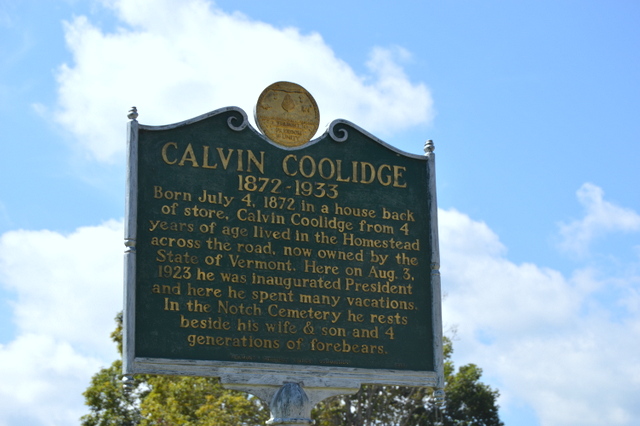
We spent the night in west-central Vermont and visited the tiny village of Plymouth Notch, hometown of Calvin Coolidge.  The village has been preserved as it was and the house he grew up was protected by an overzealous housekeeper who kept the homestead exactly the same way until the Coolidge family donated the site to the state of Vermont.  The entire village, which is not much, has been preserved as it was when he was President, including the barns, tea house, general store, church, his parent's house and even the gardens were reconstructed.  A great place to learn a bit about one of the more forgotten presidents.

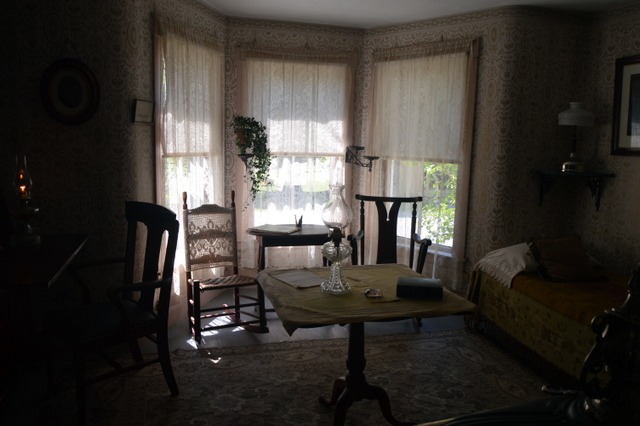
Calvin's father owned a general store and the family lived behind it where Calvin was born.  Shortly thereafter, the family moved across the street to a farmstead, architecturally known as "continuous" because the house and outbuildings are connected.  All the furnishings, including quilts and dishes were original to the house.  Raised in a Puritan ethic of hard work and fair play, Calvin was a good student and eventually made his way to college and then worked as a lawyer in Massachusetts.  He ran for school board, but lost and won the congressional seat later and became governor and then Hardin's Vice President.  Harding died in 1923 and Calvin was visiting his family in Plymouth Notch where his father (a notary public) swore him in as President.  He ran in 1924 and won and presided over the roaring 20's with no real agenda.  He did not run in 1928, leaving it open to Hoover.


General Store left.  Calvin's birthplace was a small home attached to the rear of the store.
Calvin's birthplace

The "continuous" farmstead where Calvin grew up


This barn was attached the house


Calvin's mother's home next door

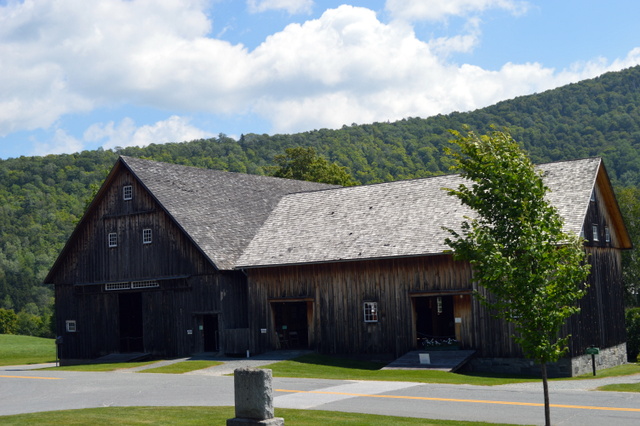
Calvin's maternal family barn


Four cent gas, including tax!


Coolidge family church and gardens
 
Gorgeous pine church interior crafted by local mill and carpenters
 

Where Calvin was sworn in as President


We headed west to skirt the end of Lake Champlain and on into New York State.  We got a campsite outside of Ticonderoga.  Thursday morning we headed over to spend the day at Fort Ticonderoga.
Near Killington, Vermont

Low clouds moved in - humidity is too high for clear photos

Fort Ticonderoga was an important part of the French and Indian War and then the Revolution.  The French and Indian War was the North American extension of Europe's Seven Year War between Britain and France.  We, of course, were on the side of the British at the time.  The fort was built in a classic French star-shaped pattern on the bluff overlooking a narrow section of Lake Champlain.  As the interpreter told us, whoever controlled the waterways, controlled territory during this time period. The British took the fort in 1759 from the French.  During the Revolution, Ethan Allen and the Green Mountain Boys along with Benedict Arnold took the fort in a surprise attack without firing a shot.

The fort fell into disrepair and sat idle, but used as a Home Depot by locals who looted it for building materials.  The Pell family bought the land in the early 1800's and decided to try to save the fort.  By the 19-teens, they established a non-profit foundation to help finance the reconstruction/preservation effort.  The costumed interpreters were the best we have ever encountered - all worked year-round for the foundation, acting as interpreters during the summer and doing historical, military, architectural, etc. research during the winter.  Excellent, excellent tours.
These guys gave a musket demonstration and then took details questons about armament and history.  Very impressive.


Although the fort's foundation was mostly intact, major reconstruction was done, exactly according to the original fort plans


Lake Champlain divides Vermont and New York.  The hill across the water is Vermont


We also took a boat tour of Lake Champlain where we learned more about the area, starting with military history and moving on to commercial and tourist activities over the centuries.

Fort Ticonderoga from Lake Champlain


Drum and Fife

Pell Family Gardens
We drove to a nearby mountaintop, called Mount Defiance that was crucial in the defense of the waterways.  It was here that the French managed to put a couple of cannons that overlooked Fort Ticonderoga and the British surrendered the fort without a shot.

Fort Ticonderoga below
We continued our drive north along Lake Champlain and got a campsite for the night in Keeseville on the northeastern border of the Adirondack Mountains.