Showing posts with label Texas. Show all posts

East Texas Oil Country, June 23, 2018

Friday
We entered Texas via a bridge into Port Arthur - a huge oil refinery town.  We passed miles of refinery pipes and buildings and venting gas belonging to Valero - ugly and a bit smelly, but must be providing a lots of jobs.  We continued on to Beaumont - another oil town for our campground south of town.

A neat, clean campground with a good laundry so I could catch up with our dirty clothes.  Laundry rooms in campgrounds often serve as the office water cooler in corporate America - and I had a great conversation with a lady who said she was local.  I wondered why she was local and here in a campground and when I asked, she said her home had flooded twice in the last few years - 6' of water that stayed for 7 days, so nothing was salvageable.  The last time, she had enough and she and her husband decided to get a big trailer (5th wheel), stay local until she retired in 6 months, and then they would travel the country and decide later where to retire permanently.  Duh!  We were wondering why we saw so many campgrounds with obviously full-time residents in motor homes and trailers and why along the back roads we saw what we thought were poor people using camping trailers as homes on residential lots - these were folks who had lost their homes and were struggling to survive.  Sure hope Mother Nature spares them from hurricanes this year.

Robot telling the story of early oil exploration in East Texas
Saturday

Well, it turns out we left hot and humid southern Louisiana for hot and humid eastern Texas.  Woke to 74 degrees with all the windows covered in condensation, so today will be yet again an "indoor" tourist day.  After some shopping, we drove into downtown Beaumont to visit their Texas Energy Museum.  Note that Texas Energy = oil, and no other type of energy.  The museum concentrated on the process of refining crude oil and we did learn a few things, but the emphasis on chemistry and reliance on  panel boards with a lot of reading meant we skipped quite a bit.  The second floor concentrated on the discovery of the first oil gusher in Texas - Spindletop.  A great story that resulted in 10,000 people coming to a rural area to "sightsee" the spectacle, along with folks hoping to get rich on an oilwell gusher.  Similar to the gold mine strike stories we heard about in northwest Canada and Alaska.
A small exhibit about off-shore drilling


They had a section on Gas Station Marketing and importance of Logos

Robots telling the story of the first Oil Well Gusher in Texas


After the museum we drove to Rau's Bakery and Cafe, opened in 1941.  The pastries were beautiful, and a large assortment of flavorful ices and gelatos made it difficult to concentrate on lunch.  Decor was 1940's with Frank Sinatra serenading us.  Jack had a cup of chicken and sausage gumbo soup and a half ham sandwhich on a fresh, buttery croissant while I had a muffaletta panini.  All were outstanding!
Gelato

Ices - love the presentation with the fruit!


These birds' colors have no indication of the sex and do not follow
the norm that the brighter colors are male.  Here we find the male a Pale
Pink and the Female a dark pink
We headed south to the Anahuac Refuge where I was hoping to see a few Snow Geese that might be hanging around after their winter nesting season.  We drove a short 3 mile loop and although there were no snow geese, we did get to see lots of wading birds, ducks and especially a pair of roseate spoonbills.  It looked to us like they were doing a bit of a mating ritual with one repeatedly chasing the other and spreading his wings.  She finally had enough and flew off, leaving him looking a bit dejected.
He is displaying what a fine catch he is

Chasing and displaying

She is ignoring and shortly afterwards, flies away


From here, we drove a little further south to the Gulf and then across Bolivar Peninsula to our campground and spent another night with the AC on.  Even though there was a nice breeze, 90 degrees at 9pm is way too hot to open the windows.

Monday, January 30, 2017: Texas to Louisiana, Big Thicket

Woke to a beautiful sunny morning with temps in the high 50's.  Great day to get outside.  Packed up the RV and headed north 30 miles to the first National Preserve - Big Thicket, Texas.  Stopped at the visitor center to see a film and learned that this area is unusual because it has so many plants and animals from different zones.  It has pine forests with desert cacti nearby as well as black swamps (they call them baygalls here).  One unique thing is there are five types of carnivorous plants in North America and four of them are found here. Unfortunately, they do not bloom until March, so another item added to the bucket list.

This area had been thousands of miles of virgin forest inhabited only on the edges by native Americans, who did not stay, but enjoyed hunting and gathering here.  Logging began after the Civil War, followed by the discovery of oil nearby in 1901 that started the great Texas Oil Boom, changing the area forever as folks arrived in droves.  Eventually, a number of key conservationists recognized they need to save what was left of the Big Thicket and so it eventually became the first National Preserve, run by the National Park Service.

After the introductory film and looking at their exhibits, I walked the short 1 1/2 mile Kirby Nature Trail that took me through forests of Oak and Beech, then pines and swamps.  Supposed to be good birding, but I was there mid-morning, and apparently most were napping.  All I saw were robins, and heard some cardinals and the insistent tapping of a woodpecker in the distance.  Lots of hurricane damage to large trees.  I did not have to worry about bears and mountain lions here as I did in Big Bend, but they do have bobcats and even panthers, but they are not seen very often.  The biggest animal I saw was a squirrel.

Looked like a lightening strike as the inside was charred 

Up close, the woodpeckers have been busy


These are everywhere in fields and alongside the roads - they are the tailings from crawdads!

It was great to walk in the woods on a lovely day before climbing aboard the Eastbound RV and getting back on I-10.  I stopped mid-afternoon in Lafayette, Louisiana.  Getting across Texas on I10 is MUCH shorter than I20 to I10.

Got a campsite in the small Lafayette city park and enjoyed sitting outside in the 75 degree sunny day.  Tomorrow, I will visit the Cajun Acadian Cultural Center and Vermillionville, both of which are not open on Mondays.

Sunday, January 29, 2017: Sanderson to San Antonio, Texas

Today was a driving day and while enduring mind-numbing dry desert landscapes, I reflected back on Big Bend, it's name coming from the big 90 degree bend that the Rio Grande makes here.  I think the biggest surprise for me was that the Rio Grande was not a large, muddy meandering river, nor was it the small stream that you would sometimes see in the old westerns as they galloped their horses through the river and across the border.


It has always been a powerful river, cutting 1,000 foot deep canyons into the rock and the and the swirling rapids in the narrowed canyons prevented its navigation until (I think) the late 1800's.

Today's Rio Grande current can be deadly, even where it looks calm.  But, the river is much smaller because so much water is removed for irrigation.  Where the river had been wide, muddy and meandering, it is now often broken into a smallish main channel and even smaller side channels.  When it does flood, however, it covers vast areas because except for the rocky canyons, the surrounding landscape is so flat.

Float trips can be done through the canyons, but it is at least a full day trip.  They say the river carries so much sand that on a float trip you can actually hear it grinding away under the raft.  Another item for the bucket list.


Back to driving..... I followed US Route 90 east across south Texas.  On my approaching Big Bend on I-10 and Route 90 as well as leaving and driving Route 90 east, I encountered four border patrol stops where they had dogs and could (but didn't) inspect every vehicle.  But every vehicle was stopped and driver questioned.  I did see some vehicles that were being searched.  I also passed dozens and dozens of border patrol SUVs patrolling along the fenced ranchlands between the highway and the border.

Once I got to Del Rio - a nice little city, the landscape began to change from the dry desert to irrigated plowed fields.  More towns, closer together and lots of green stuff - grass, trees, and in general, much more to see and enjoy.  Just before Del Rio, I crossed the Pecos River and stopped by the overlook to get some photos.  There is a major reservoir in the area called Amistad that is a joint damming project of Mexico and the USA.  After being in the desert so long, it was wonderful to see a large body of water!
Pecos River


Stopped for the night just outside San Antonio.  I have been to the Alamo a few times as well as the Riverwalk, so will not be making any stops here, but continuing east, but now back on I-10.


Sunday, January 15, 2017: Davis Mountains, Texas

Two nights ago, I was at a nice Army Corps of Engineer Campground where mule deer spent the early evening grazing around the campsites.

Today, I started early because the forecast was for high winds in the afternoon and the RV is just not fun to drive under those circumstances.

I headed west on I-10 and then drove south 25 miles to Ft. Davis, and got a campsite at the State Park.  The weather finally started clearing and the winds picked up, but I decided to drive the 75 mile scenic Davis Mountains loop.  It was a beautiful drive and I enjoyed seeing the sun and the mountains after the last three days of gloomy skies and flat scrubland.


I stopped briefly at the McDonald Observatory, but their tour was going to take three hours and that would not give me time to finish the scenic drive.  I was going to take the self-guided tour, but when I made the turn to go to the telescopes, a big sign said NO RVs.  Bummer.

The newest and largest telescope at 394".

I finished driving the scenic loop through the mountains on the highest highway in Texas, encountering a short snow squall at the higher elevations, but returned to 50 degrees at the bottom and sunny skies.


Views of the Observatory with the older, smaller telescopes on the left

Many warning signs about not driving through standing water with these gauges next to the road to show just how high the water can get from flash floods


This formation is called Sawtooth


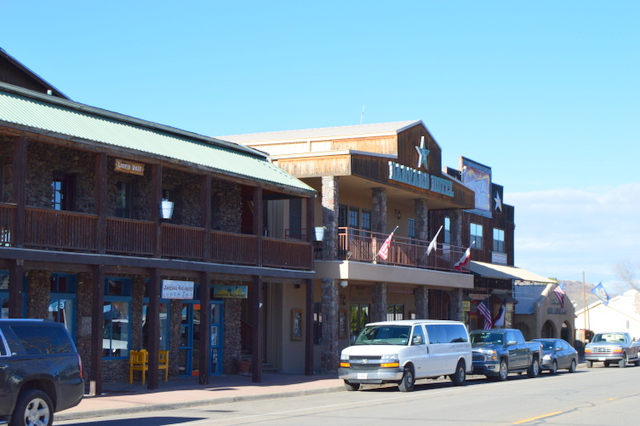
The small downtown Fort Davis
I returned to the State Park and set up camp, then took a walk around the park.  No phone, no reliable internet, no tv here, but did find one NPR station so I could at least hear the news.

Incredible stargazing here because of the extra dark skies, but too windy and cold for me to enjoy the stars for long.